BACKGROUND OF THE INVENTION 1. Field of the Invention
[1]
The present disclosure relates to a solar panel, and more particularly to a solar panel configured so that as many solar cells as possible can be arranged without any gaps within a certain limited area.
2. Description of Related Art
[2]
In order to achieve carbon neutrality, attempts are being made to install solar panels on the roofs or the like of vehicles such as automobiles or other moving bodies, and to use the solar energy obtained thereby to drive the vehicles. When installing a solar panel on the roof or the like of such a moving body, the area in which the solar panel can be disposed is limited. In order to collect as much solar energy as possible in a certain limited area to obtain an amount of power generation, various proposals have been made on configurations that enable as many solar cells as possible to be arranged without gaps in the panel.
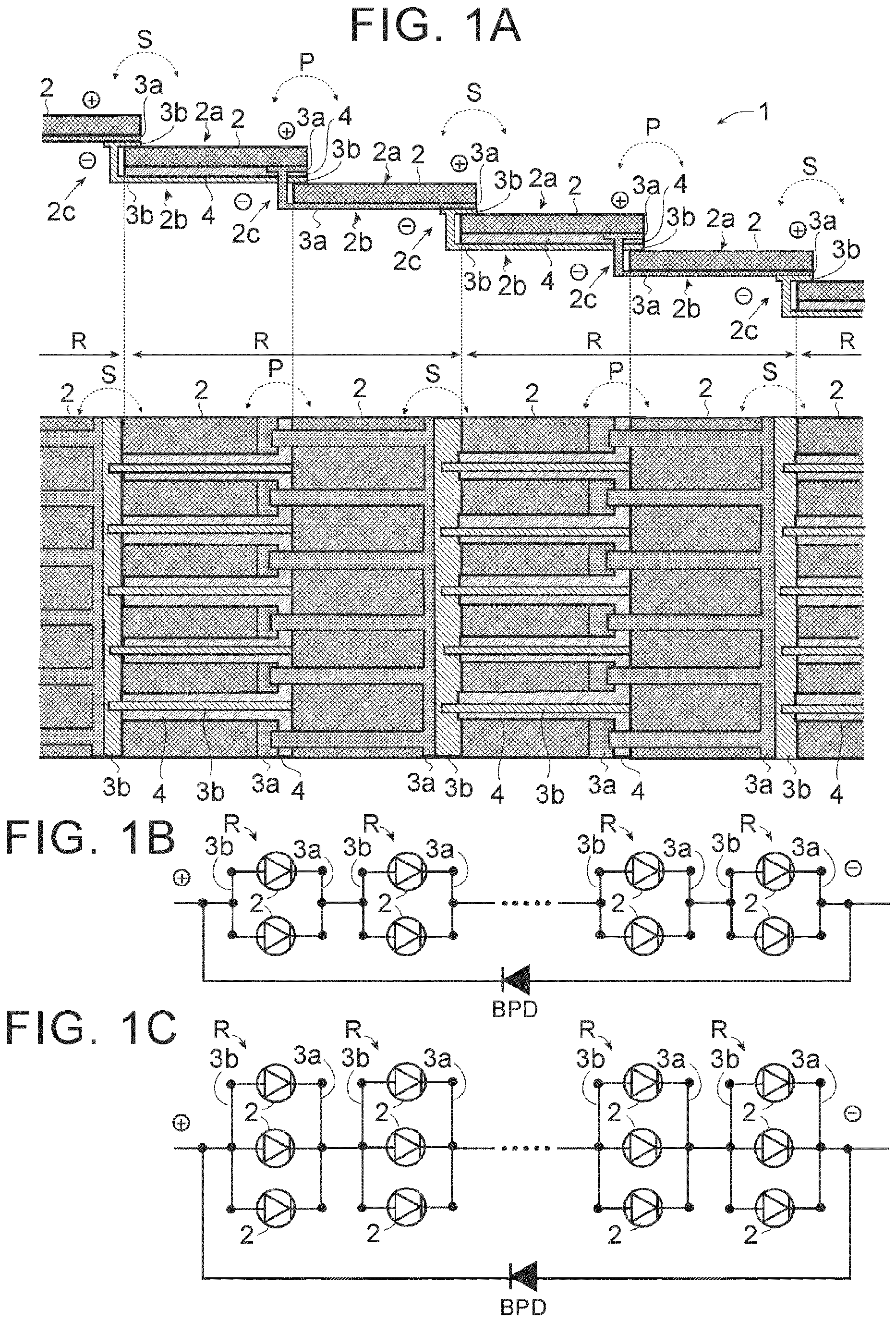
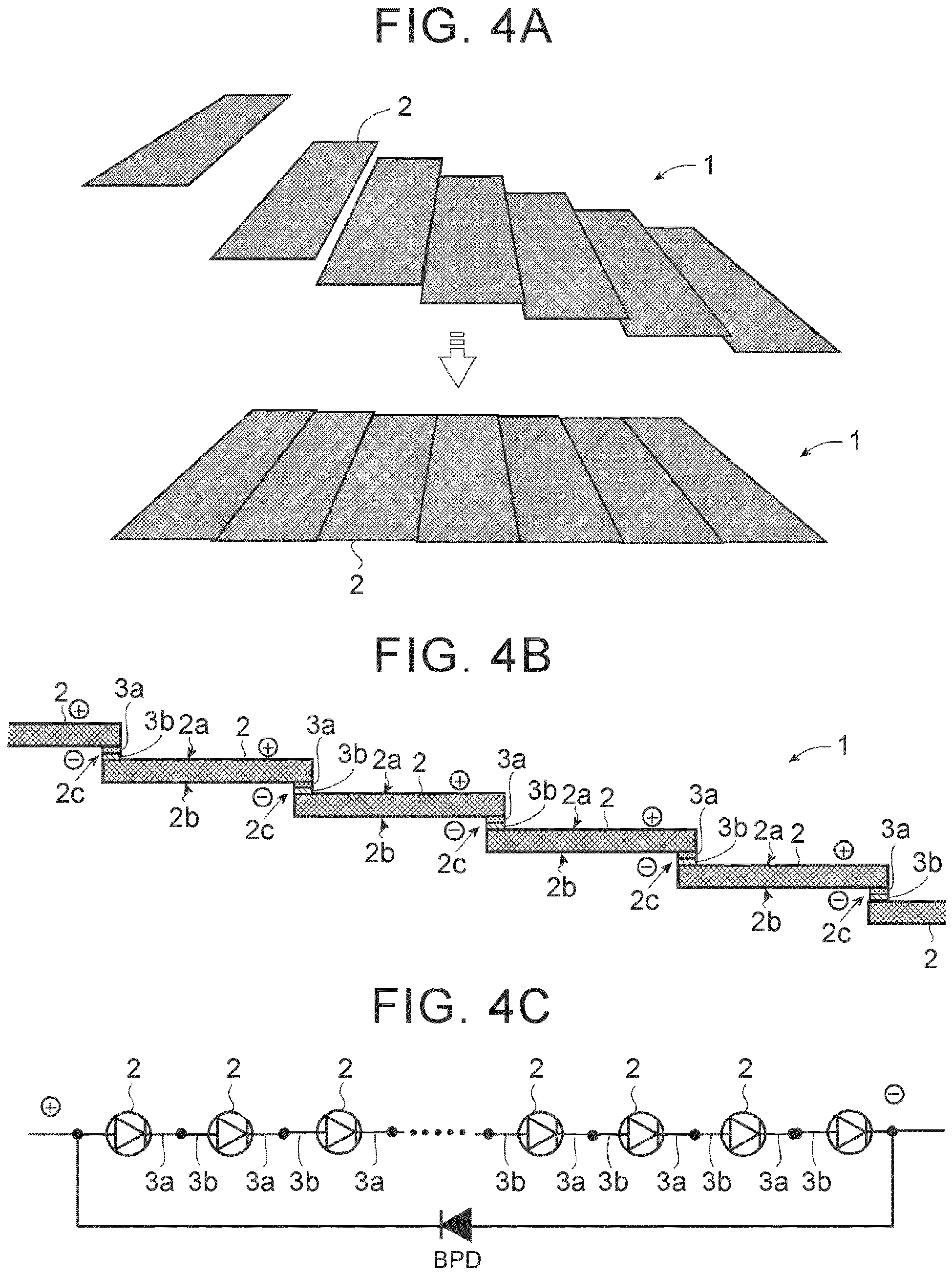
For example, in Japanese Unexamined Patent Application Publication No. 2021-082722 JP2021082722A ( JP 2021-082722 A JP2021082722A ), WO 2020/031574 WO2020031574A , etc., a plurality of solar cells is arranged side by side in one direction in a panel. The solar cells are arranged so that the surface on the back side (back surface) of a certain solar cell partially overlaps the edge of the surface on the front side (front surface) of an adjacent solar cell. At the overlapped portion, the adjacent solar cells are electrically connected via conductive members. It has been proposed to use this "shingling structure" or "shingling method" (see FIG. 4A ). In particular, JP 2021-082722 A JP2021082722A proposes an arrangement configuration that can suppress a decrease in the output when arranging a plurality of solar cells with different power generation areas in a configuration in which a plurality of cells arranged in the shingling structure is connected in series. Further, in WO 2020/031574 WO2020031574A , a plurality of configurations (strings) in which a plurality of solar cells is connected in series and arranged with the shingling method is arranged in a direction intersecting the arrangement direction of the solar cells. A common member is used to electrically connect adjacent solar cells in each string. Each cell is connected in series with another cell in one string and is connected in parallel with the corresponding cell in another string. It is described that this configuration can be expected to suppress output reduction due to mismatch of the current between a plurality of strings.
SUMMARY OF THE INVENTION
[3]
In a solar panel, for example, if the entire surface of the area where sunlight reaches (sunlight reaching area) is covered with a single solar cell (hereinafter referred to as "cell"), the generated voltage is low, but the generated current increases, which increases the amount of heat generated (Joule heat). In order to avoid this, as described above, a configuration is adopted in which a plurality of cells is arranged in the sunlight reaching area and connected in series to increase the generated voltage in the panel and decrease the generated current. In addition, rather than forming a single cell that entirely covers the sunlight reaching area, arranging a plurality of small-area cells side by side in accordance with the shape of the sunlight reaching area is advantageous in that it can facilitate work and operation in manufacturing and installing solar panels and the like. In this case, when the shingling structure described above is adopted, a plurality of cells can be arranged almost without gaps in the sunlight reaching area. Therefore, substantially the entire sunlight reaching area is covered with the light receiving surfaces of the cells, which makes it possible to obtain as much solar energy as possible from the panel as electrical energy.
[4]
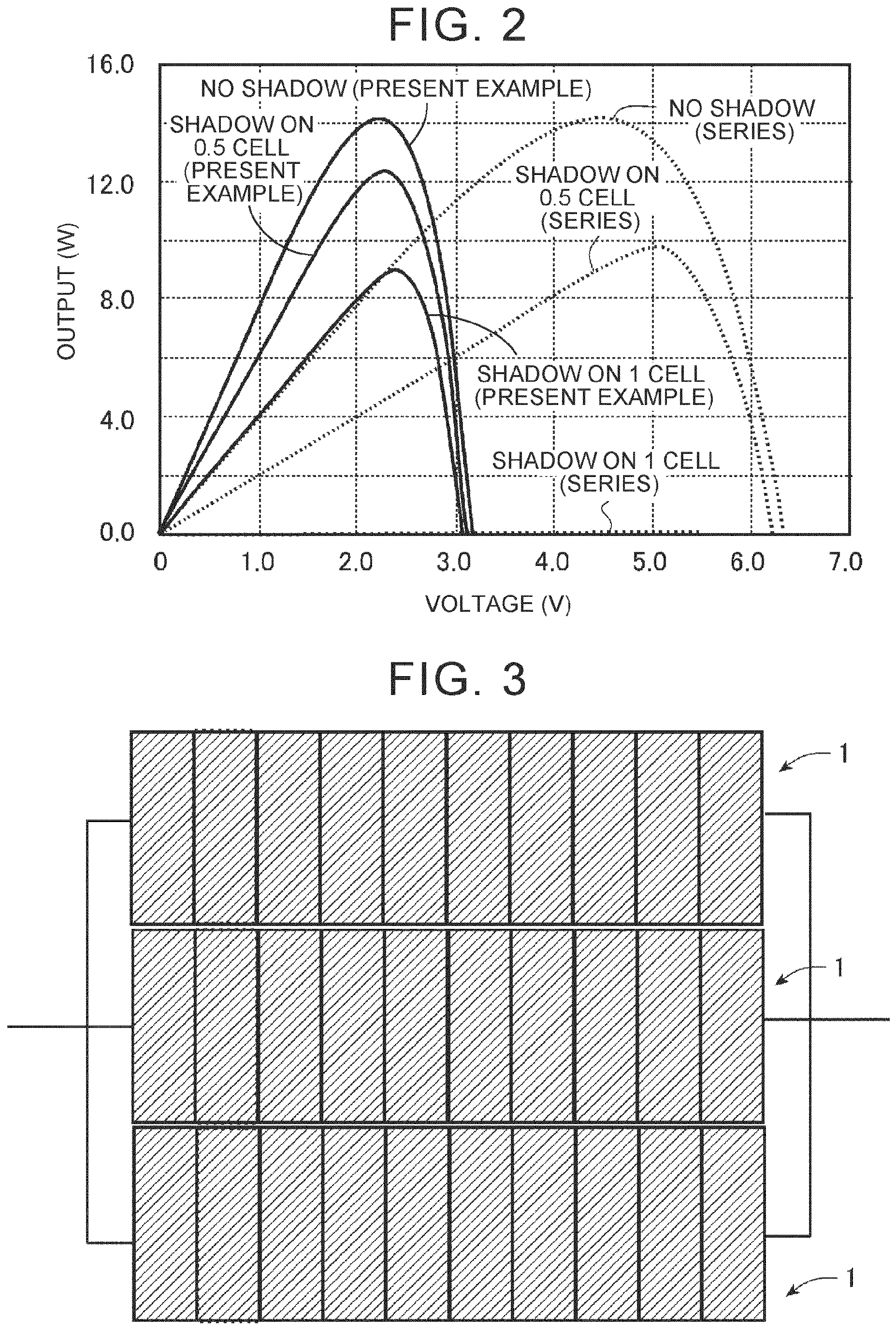
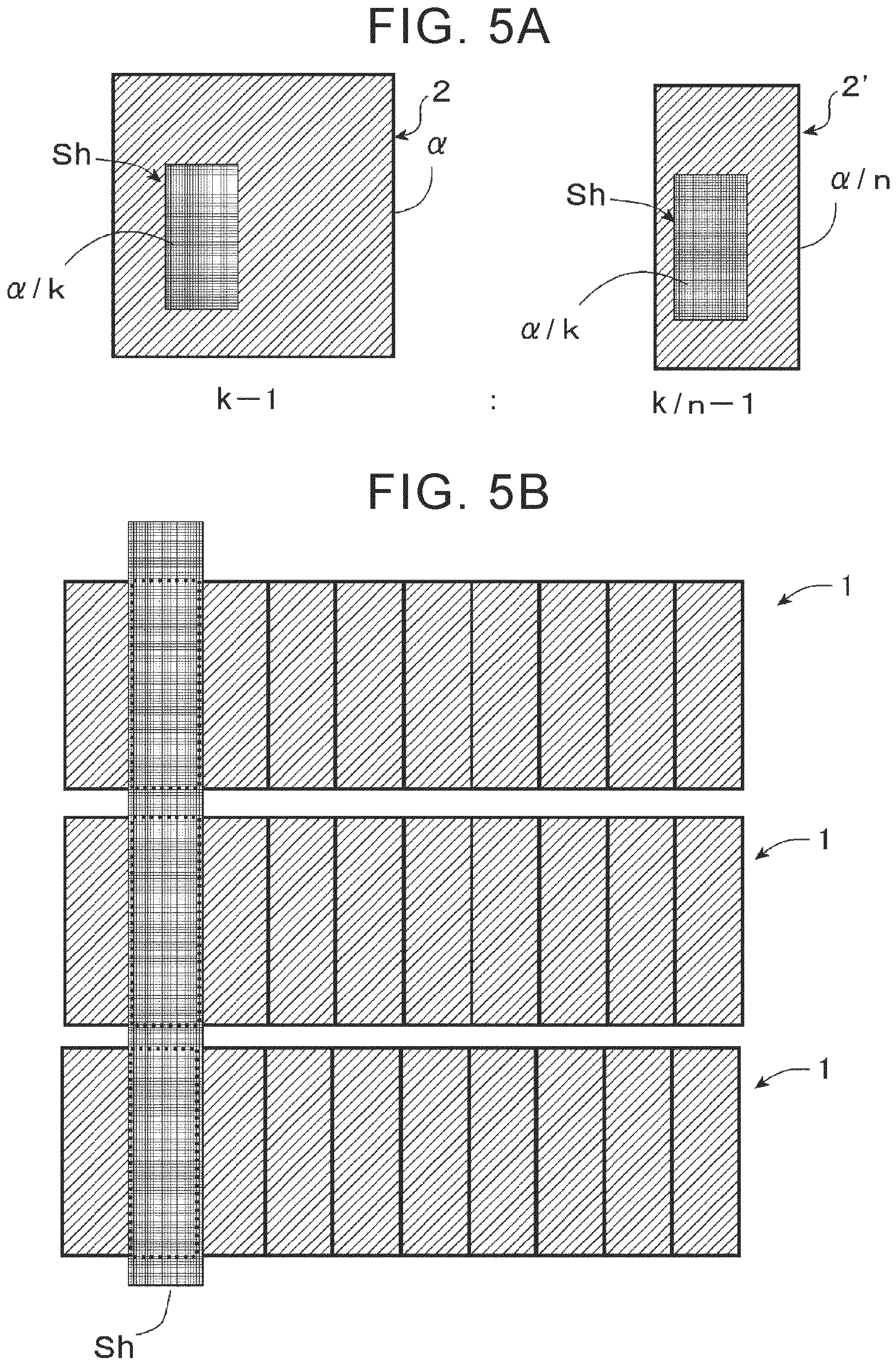
The solar panel adopting the shingling structure as described above typically consists of a plurality of cells arranged along one direction and electrically connected in series, in other words, a group of cells called "strings". One or more cell groups are arranged to cover the entire sunlight reaching area of the panel. In this case, all cells are connected in series in each cell group. Accordingly, the magnitude of the generated current obtained in each cell group is limited to the magnitude of the generated current in the cell having the smallest generated current among the cells in the cell group. Therefore, when a partial shadow is formed in the sunlight reaching area of the panel and the amount of light received by some cells is reduced, the generated current of the cells with the reduced amount of light is reduced. This is because the generated current of each cell increases or decreases in accordance with the increase or decrease in the amount of light received by each cell. Therefore, the generated current obtained from the cell group to which the cell belongs is also reduced. For example, if the entire surface of a cell is in partial shadow, current will not flow through that cell. Thus, no current flows through the cell group to which the cell belongs. In addition, as shown in FIG. 5A , in a solar panel with the shingling structure, the sunlight reaching area is covered with a plurality of cells. That is, the area of the light receiving surface of each cell is smaller than the sunlight reaching area of the panel. When a partial shadow of a certain size occurs in one cell, the smaller the light receiving area of the cell, the greater the decrease rate of the current. Therefore, in a cell group with the shingling structure in which all the cells are connected in series, the decrease rate of the generated current when a certain partial shadow occurs will be larger than the decrease rate of the generated current when the same partial shadow occurs in a cell with the same area of the above cell group. Furthermore, as shown in FIG. 5B , with a plurality of cell groups in the form of strings having shingling structures arranged side by side in a solar panel, if an elongated shadow that covers one cell in each cell group (such as a shadow caused by trees or utility poles) occurs, when all the cells in each cell group are connected in series, current cannot be obtained in all cell groups and power cannot be taken out. Therefore, in a solar panel, in a configuration in which a plurality of cells is arranged in a so-called "shingling structure" over the sunlight reaching area, it is advantageous when, even if a partial shadow that covers one cell is formed, the generated current of other cells can be taken out from the cell group to which that cell belongs.
[5]
The present disclosure provides a solar panel configured such that, in a cell group in which a plurality of cells is arranged in a shingling structure, even if one cell is covered with a partial shadow, the current generated by the other cells can be taken out.
[6]
An aspect of the present disclosure is a solar panel including: a cel…