FIELD OF THE INVENTION
[1]
The invention relates to a solar panel arrangement and a method for controlling a solar panel.
BACKGROUND OF THE INVENTION
[2]
The effect of a fixed solar panel is limited. Therefore solar tracking is also used which means that the solar panel is turned to follow the sun. Solar tracking typically requires a complicated and cumbersome structure for the arrangement.
BRIEF DESCRIPTION OF THE INVENTION
[3]
An object of the present invention is to provide a new solution. The objects of the invention are achieved by what is stated in the independent claims. The preferred embodiments of the invention are disclosed in the dependent claims.
BRIEF DESCRIPTION OF THE DRAWINGS
[4]
In the following the invention will be described in greater detail by means of preferred embodiments with reference to the attached drawings, in which
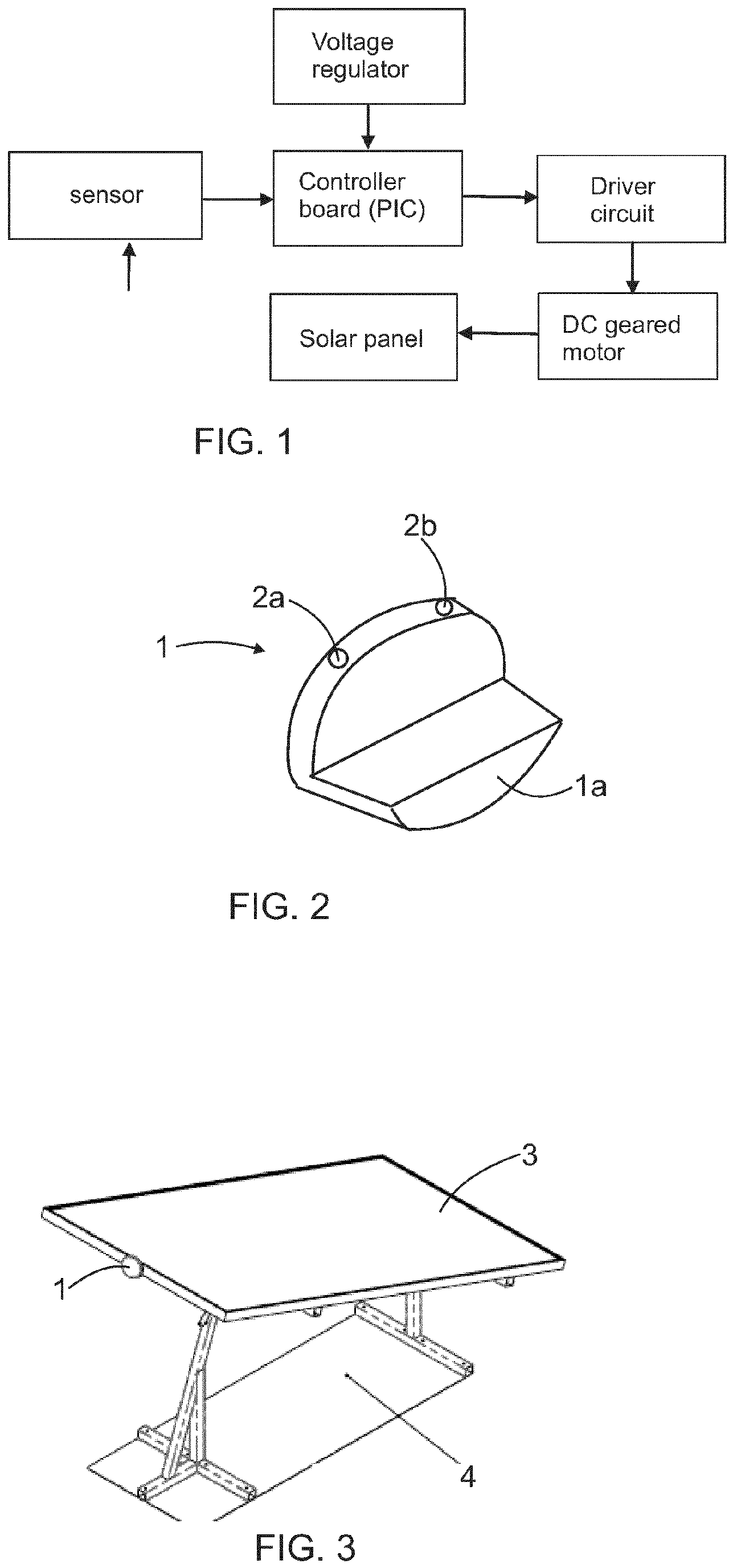
Figure 1 is a function diagram of a solar panel arrangement; Figure 2 schematically shows a controller; Figure 3 schematically shows a solar panel arrangement; Figure 4 schematically shows a side view of the solar panel arrangement of Figure 3 ; and Figure 5 schematically shows a two-sided movable joint.
DETAILED DESCRIPTION OF THE INVENTION
[5]
In this description the terms solar panel, photovoltaic panel and PV panel are used of the same device.
[6]
Microprocessor and Electro-Optical Sensors tracking method is used in tracking the sun for PV panels.
[7]
The methodology is usually the same throughout different systems but there are a few minor differences among sensor types and accuracies. The most common type of microprocessor and electro-optical solar tracking system consists of a few basic components: power transformer, smart unit (microcontroller), light sensors, motor drives and motors.
[8]
Power transformation is the first step to achieving solar tracking. The transformation of power is needed upon the different electronic use requirements, usually standard values: 3.3V, 5V, 12V and 24V. In most cases the motor operates in a different voltage than the electronics, therefore the motor driver operates in two different voltages that should be supplied by the transformer. Standard voltage transformers are widely available in the market for purchase but in utmost cases, the transformer has to be designed by the system designer due to specific input and output voltages and currents.
[9]
The computing part of the solar tracking system can be any type of computer that has the ability to calculate input data supplied by the sensors. The main task of the computer is to locate the sun based on the difference in light intensity sensed by the sensors. The locating of the sun is accomplished by setting an equal value point in between sensors. As the sensors are placed in a different angle form one another, they will be receiving different light intensity, by moving the platforms and searching the position until all the sensors have equal value, the sun tracking is achieved.
[10]
Different computers are used for different applications. In solar tracking, the complexity of the system is much easier and does not require much computing power. It is efficient to use the microcontrollers as a computer in the tracking systems. A microcontroller has its own internal RAM and ROM memories and it is all integrated in a single microchip. Dependent on the application, the solar tracking system has few inputs and outputs. Inputs can be the light sensors (two per axis), limit switches, interface buttons or other interface modules. The outputs will be the motor driver pins, two per motor (if the motor is DC), light indicators, data transmission connections etc.
[11]
The light sensors are the first component that has contact with the sun. Different light sensors are used for different accuracies. The most common used ones are called photodiodes and photo resistors. Photodiodes and photo-resistors operate in the same principle - by changing values of resistance due to light intensity changes. It is known that a normal microcontroller cannot detect any resistance changes, the photodiodes have to be connected in series with resistors of higher value and a signal voltage to be applied through the connection. As the resistance of the sensor changes due to light intensity, the voltage across the connection changes also.
[12]
The difference between sun tracking sensors, is ability to detect different light intensity and waves. As every tracking system has motors to accomplish movement towards sun, the motors need to be controlled. Motor drives help the system attain a controlled movement and perform the desired output. A motor drive depend on the type of the motor used. For a conventional DC motor, the drives are very simple and the designer can build it, as for other types of motors such as servomotor or stepper motor, the drives are much more complex and costly. As stated previously the most commonly used drives in solar tracking applications are DC motor drives. Through a drive, you can variate the speed, torque, position, brakes, and reverse rotation.
[13]
The motor is the part that may execute all the calculation and the sun sensing that is performed by the electronics. The motor may provide the movement towards the sun of the tracking structures. Different motors provide different type of movements, accuracies and force. In a sun-tracking platform, the motor is used with a gearbox providing a gear ratio confiding on rotational force and speed. As the system aims to achieve higher tracking accuracy, the type of the motor has to be more easily controllable in different positions. For example, a stepper motor provides the control of different steps in a rotating axle.
[14]
Stepper motors are motors that move in single steps and work with DC. They have different phases (coils with individual magnetic fields). By energizing each phase in sequence, the motor will rotate, one-step at a time. This motor allows very precise positioning in each phase if a computer is used as a controller. A stepper motor is the first choice motor if the tracking system aims higher accuracy. Stepper motors vary in size, power and electrical characteristics.
[15]
Another type of motor in the solar tracking systems is a normal DC motor that drives an actuator. These available linear actuators typically have a DC motor mounted beside the threaded section that is driven by a belt and pulley or by gears. The threaded or spindle section is contained in a tube. A fixed nut is connected to an over tube that pushes an actuation rod in and out. This type of DC linear actuator has two integrated limit switches that are connected in series with two diodes. The function of the limit switches is so that the rod movement is controlled and the function of the diodes is to keep the motor enabled in opposite direction after the limit has been reached.
[16]
The presented solution makes an easier approach to tracking system. The presented solution may provide the existing single PV pa…