Карточка документа

Solar panel mounting

ID EP2362162B1_20140212
Страна EP Номер 2362162 Вид B1 Дата 2014.02.12

Основная информация

Страна публикации
EP
Номер документа
2362162
Вид документа
B1
Дата публикации
2014.02.12
Номер заявки
10250305.9
Дата подачи заявки
2010.02.22

Классификация

МПК

  • F24J2/46
    Раздел F
    Класс 24
    Подкласс J
  • F24J2/52
    Раздел F
    Класс 24
    Подкласс J
  • H01L31/048
    Раздел H
    Класс 01
    Подкласс L
  • F24J2/54
    Раздел F
    Класс 24
    Подкласс J

CPC / СПК

  • F24J2/526
    Раздел F
    Класс 24
    Подкласс J
  • F24J2/4621
    Раздел F
    Класс 24
    Подкласс J
  • F24J2/5205
    Раздел F
    Класс 24
    Подкласс J
  • F24J2/5247
    Раздел F
    Класс 24
    Подкласс J
  • F24J2002/4665
    Раздел F
    Класс 24
    Подкласс J
  • F24J2002/4672
    Раздел F
    Класс 24
    Подкласс J
  • F24J2002/5281
    Раздел F
    Класс 24
    Подкласс J
  • F24J2002/5284
    Раздел F
    Класс 24
    Подкласс J
  • F24J2002/5486
    Раздел F
    Класс 24
    Подкласс J
  • H02S20/23
    Раздел H
    Класс 02
    Подкласс S
  • Y02B10/12
    Раздел Y
    Класс 02
    Подкласс B
  • Y02B10/20
    Раздел Y
    Класс 02
    Подкласс B
  • Y02E10/47
    Раздел Y
    Класс 02
    Подкласс E

Служебные сведения

Dataset
ep
Index
pmi2e_ep

Участники

Заявители

  • Нет данных

Авторы / изобретатели

  • Marriott, Adam
  • Hock, Jonathan

Патентообладатели

  • Baxi Heating (UK) Limited

Формула

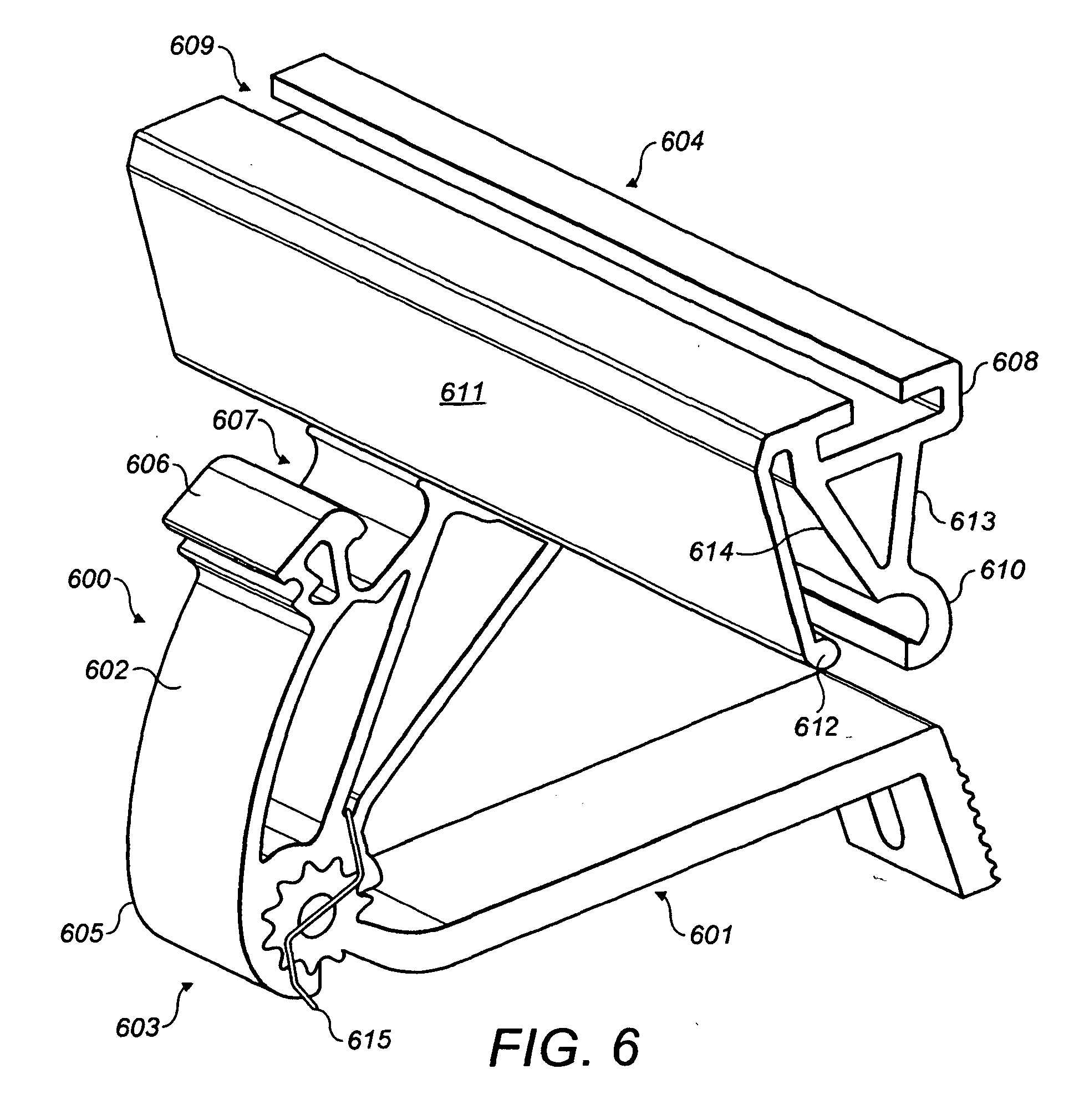
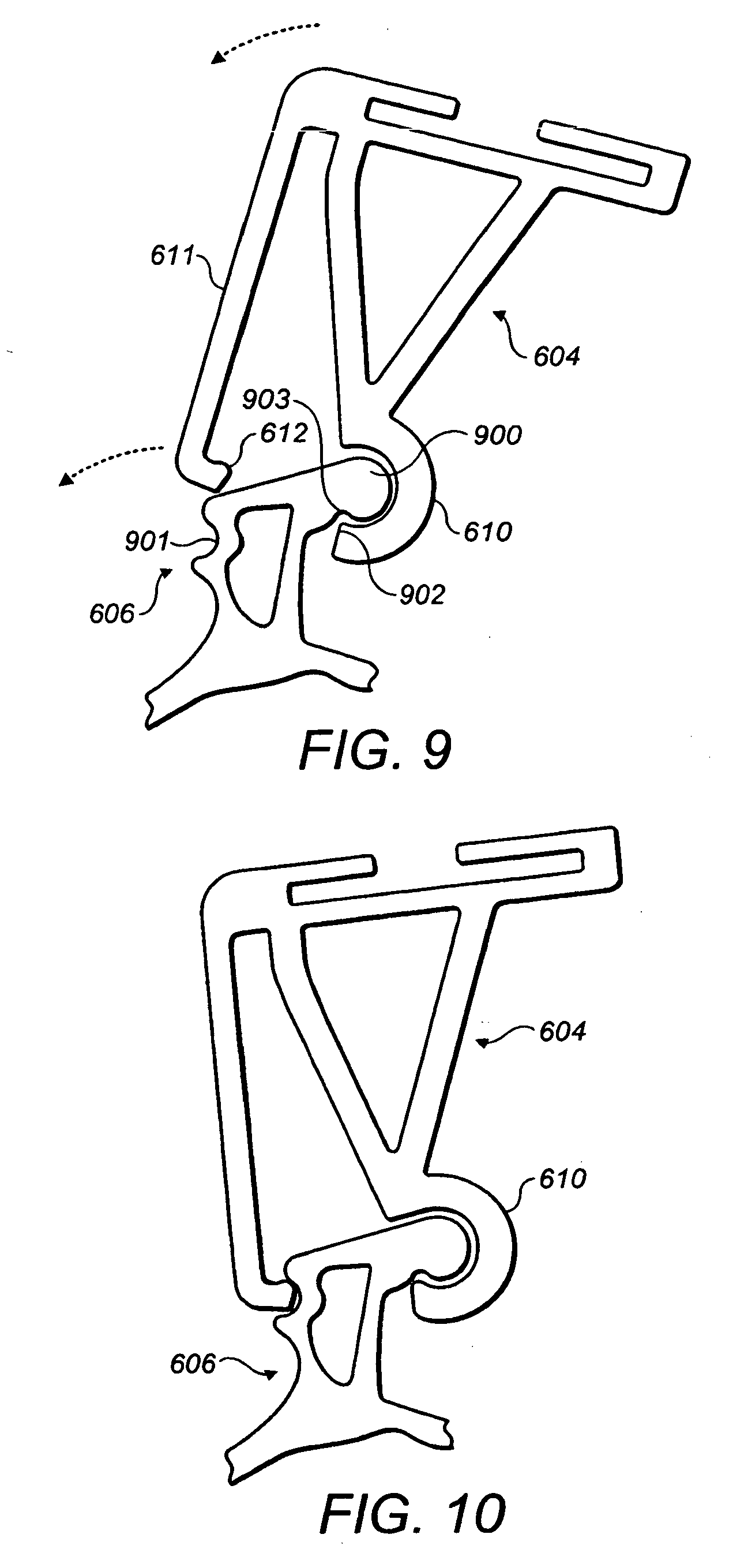
A mounting kit for a solar panel, solar array, said mounting kit comprising at least one mounting bracket (600) and at least one beam (604),

each said at least one beam (604) comprises:

a rigid elongate body portion;

a first engaging portion (610) extending from said body portion and attached thereto;

a second engaging portion (612) facing opposite and spaced apart from said first engaging portion (610), said second engaging portion (612) being attached to said body portion;

wherein said second engaging portion (612) is positioned in a fixed spatial relationship to said first engaging portion (610) when no force is applied to said at least one beam; and

said first and second engaging portions (610, 612) are capable of moving apart under applied force; and

each said at least one mounting bracket comprises one or a plurality of mounting parts, each mounting part comprising:

a head portion;

a first engaging region (900) positioned at a rear of said head portion; and

a second engaging region (901) positioned at a front of said head portion;

said head portion being positioned between said first rearwardly positioned engaging portion and said second, forwardly positioned engaging portion;

wherein said first engaging portion (610) of said at least one beam (604) is configured to engage said first engaging region (900) of said at least one mounting part; and

said second engaging portion (612) of said at least one beam (604) is configured to engage said second engaging region (901) of said at least one mounting part; and characterized in that the at least one beam (604) is configured to engage

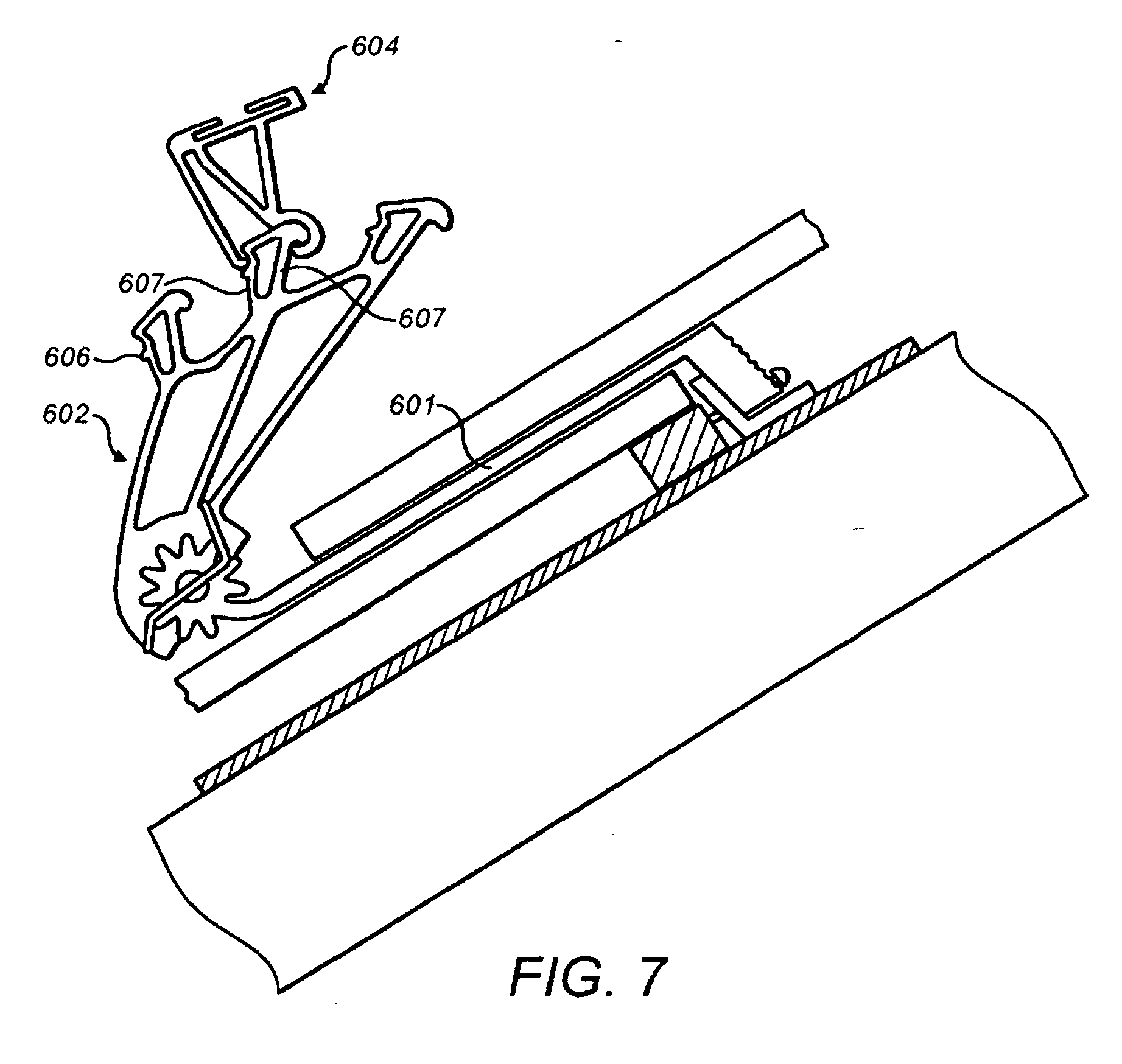
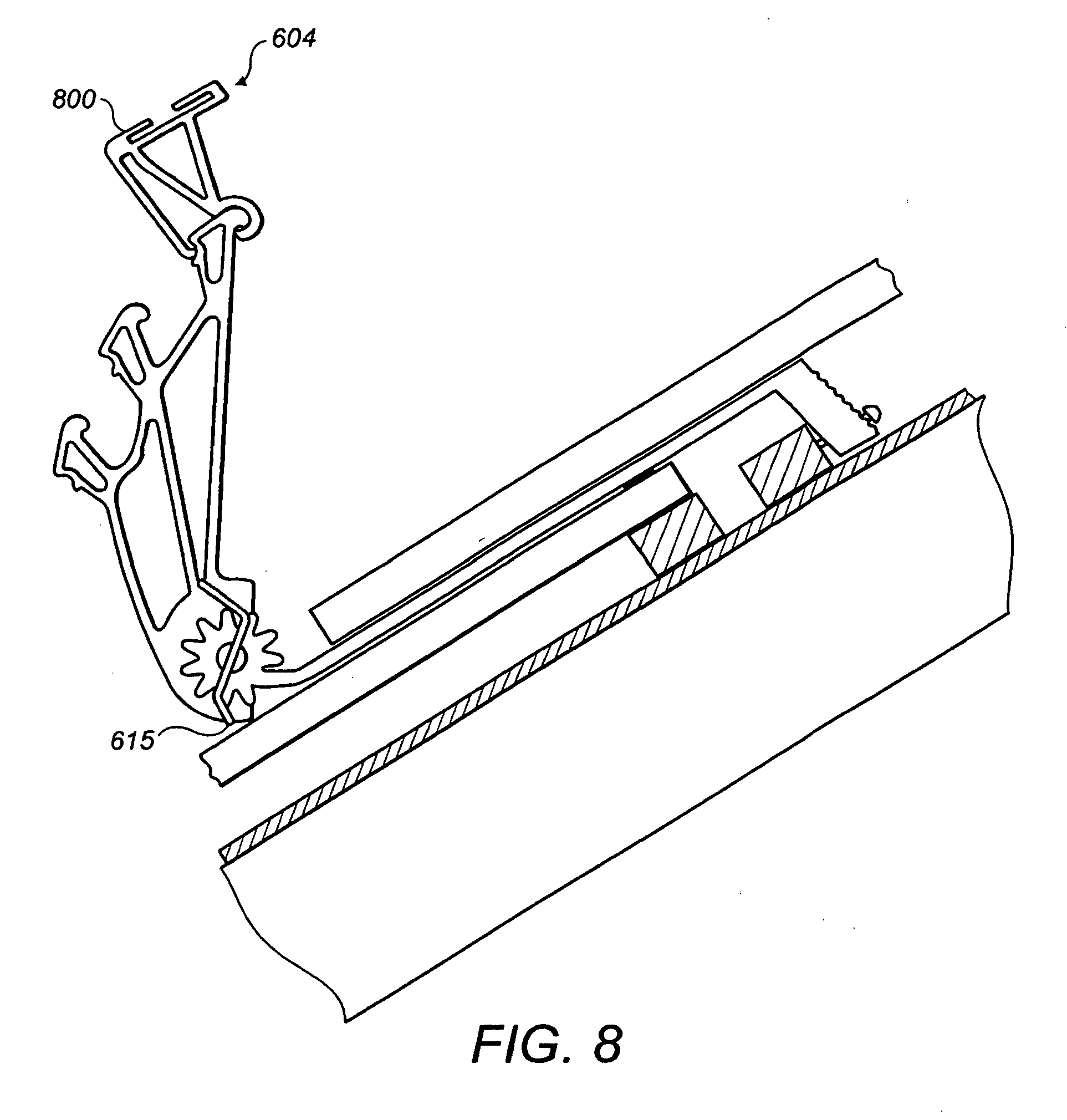
to said at least one mounting part by applying a rotational and translational movement of said at least one beam (604) relative to said mounting part.

The mounting kit as claimed in claim 1, wherein said at least one beam (604) and said at least one mounting part are connectable to each other by applying a said rotational and translational movement in a direction transverse to a direction parallel to a main length of said at least one beam (604).

The mounting kit as claimed in claim 1 or 2, configured such that engagement or disengagement of the at least one beam (604) from the mounting head may be achieved by applying sufficient force for the head portion of the at least one mounting part to temporarily extend the distance between the first and second engaging portions of the at least one beam to allow the head to pass between said first and second engaging portions (610, 612).

The mounting kit as claimed in any one of the preceding claims, wherein said at least one beam (604) is configured to engage a pair of mounting parts of a corresponding respective pair of said at least one mounting brackets (600), without the need for tools.

A beam (604) for mounting a solar panel, solar array, said beam comprising:

a rigid elongate body portion;

first engaging portion (610) extending from said body portion and attached thereto;

a second engaging portion (612) facing opposite and spaced apart from said first engaging portion (610), said second engaging portion (612) being attached to said body portion, wherein said second engaging portion (612) is positioned in a fixed spatial relationship to said first engaging portion (610);

wherein said second engaging portion (612) is capable of moving with respect to said body portion, such that a distance between said second engaging portion (612) and said first engaging portion (610) is capable of temporarily increasing under applied force; and

said second engaging portion (612) returns to its original spaced apart relationship with respect to said first engaging portion (610) once said applied force is removed, and characterized in that

said first engaging portion (610) comprises a curved surface which, in use is capable of acting as a bearing for rotation of said beam (604) about an axis of rotation parallel to a main length direction of said beam.

The beam as claimed in claim 5, wherein said first and second engaging portions (610, 612) are capable of moving apart under applied force.

The beam as claimed in claim 6, wherein said first engaging portion (610) comprises a peripheral protrusion adjacent said curved surface.

The beam (604) as claimed in any one of claims 5 to 7, wherein:

said beam (604) comprises a downwardly extending skirt (611) attached to said rigid body portion;

said second engaging portion is positioned at a lower end of said skirt (611);

said skirt (611) is capable of deforming with respect to said rigid body portion, such that a distance between said second engaging portion and said first engaging portion (610) is capable of temporarily increasing under applied force; and

said downwardly extending skirt (611) returns to its original spaced apart relationship with respect to said first engaging portion (610) once said applied force is removed.

The beam (604) as claimed in claim 8, wherein:

said first engaging portion (610) comprises a curved engaging surface;

said skirt (611) is normally in fixed spatial relationship to the body of the beam and to the curved engaging surface of the beam when no force is applied to the engaging portions; and

the skirt (611) is capable of deforming relative to the curved engaging surface under a force applied between a lower end of said skirt (611) and said curved surface; and

the skirt (611) is capable of returning to its fixed spatial relationship with respect to said curved engaging surface once said force is removed.

The beam (604) as claimed in any one of claims 5 to 9, wherein said second engaging portion (612) comprises a protruding ridge.

The beam (604) as claimed in any one of claims 5 to 10, adapted to be attachable to an external mounting by a rotational and translational movement under manipulation by the human hand and without the need for tools.

A mounting bracket (600) for mounting a solar collector, solar array, said mounting bracket having at least one arm (901), and comprising:

one or a plurality of mounting parts each comprising:

a first engaging region (610) at a rear of said at least one mounting part; and

a second engaging region (612) at a front of said at least one mounting part;

characterised in that :

said first engaging region comprises a curved surface capable of acting as a bearing surface for rotation of a beam about an axis of rotation which is transverse to a line passing through said first and second engaging regions.

The mounting bracket (600) as claimed in claim 12, comprising:

a head portion; and

a neck portion;

wherein said head portion has a greater dimension than said neck portion;

said head portion comprising:

said first engaging region (900) positioned at a rear of said head portion;

said second engaging region (901) positioned at a front of said head portion; and

said head portion being positioned between said first rearwardly positioned engaging portion and said second, forwardly positioned engaging portion.

The mounting bracket as claimed in claim 13, wherein:

said head portion comprises a substantially flat upper surface; and

said second engaging region comprises a projecting lip (902).

A method of installation of a mounting kit according to any one of claims 1 to 4 for a solar panel, solar array, said method comprising:

installing a plurality of mounting brackets (600) to a structure, such that at least a pair of said mounting brackets (600) are aligned in a same orientation and opposite each other; and

attaching a beam (604) to a mounting part of each said plurality of mounting brackets (600) simultaneously, by moving said beam (604) in a translational and rotational movement relative to said mounting parts.

Описание

Field of the Invention
[1]
The present invention relates to mountings and particularly although not exclusively to roof mountings for solar panels, solar arrays and the like.

Background to the Invention
[2]
Roof mounted solar panels for domestic or commercial buildings are known in the art. Solar panels can be of various types including photovoltaic cell panels which convert incident sunlight directly into electricity, or thermal collectors comprising arrays of evacuated tubes, which heat a fluid which is passed through a domestic hot water store where heat is transferred to a domestic hot water supply.

[3]
Each of these known types of solar panel generally comprise a flat panel structure which is mounted facing into the sun, typically at an angle to the horizontal. Typical solar panel dimensions can be in the range of area approximately 1.5 x 2.5 meters 2 , and depth 5 to 12cm.

[4]
Documents FR 2369446 FR2369446 , DE 19652568 DE19652568 , DE102006041647 DE102006041647 disclose a mounting kit, a beam, a mounting bracket and a method of installation of a mounting kit according to the preamble of claims 1, 5, 12 and 15.

[5]
In the United Kingdom and other regions having a temperate climate, pitched roofs are common, and it is known to mount solar panels approximately parallel to the main outer surface of a pitched roof.

[6]
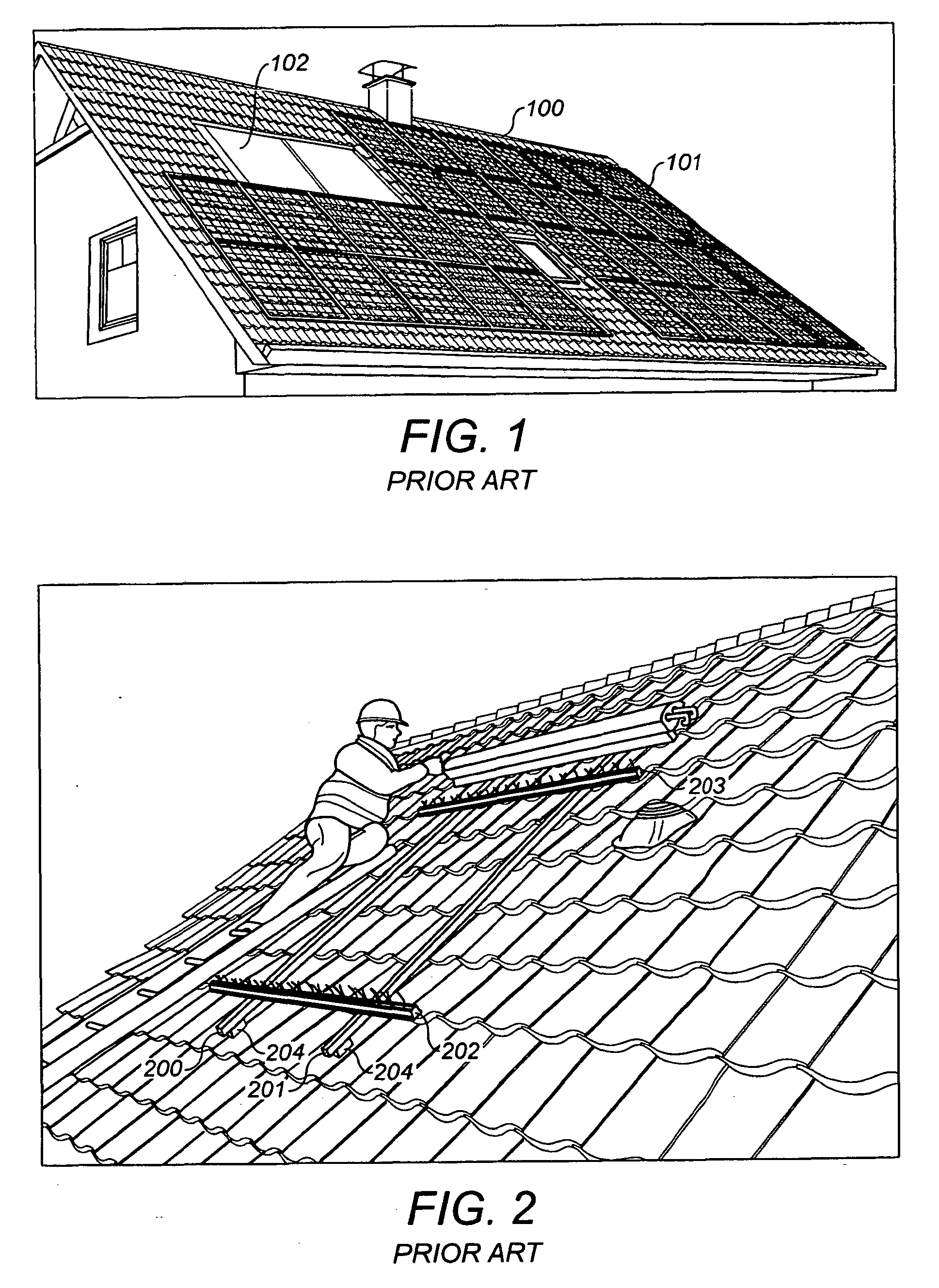
Referring to Figure 1 herein, there is illustrated schematically an installation of an array of known solar panels fixed to a pitched roof 100 of a house. In this example, the panels comprise a mixture of photovoltaic panels 101, and flat solar collector panels 102 having internal fluid tubes for heating domestic hot water. In this example, the photovoltaic panels are mounted parallel to and above a pitched tiled roof 100.

[7]
The cost and problems with installation of solar panels of all types is a major inhibitor to their widespread domestic and commercial adoption. Whilst new build housing can be more easily designed to incorporate solar panels on roofs, the majority of domestic housing and commercial buildings are legacy building stock already built. Consequently, to achieve wide spread adoption of solar panel technology requires fitting solar panels to existing roofs.

[8]
One common type of roof in western Europe is the tiled or slate pitched roof of know construction. Such roofs comprise a plurality of angled upright beams extending between a ridge and an eave, over which is positioned a waterproof membrane. On top of the water proof membrane are placed a plurality of horizontally spaced apart wooden battens, and on to those battens, are fixed roof tiles or slates, using roofing nails. Once constructed, fitting solar panels to such roofs usually requires two or more persons to have access to the outside of the roof via ladders or scaffolding.

[9]
There are generally two types of known installation which include (a) a flush fitting or "in roof" fitting and (b) externally mounted or "on roof".

[10]
In a flush "in roof" fitting installation as shown at 102 in Figure 1 , the solar panels are fitted in place of roof tiles or slates, and form the outer covering of the roof. Retrospective fitting of flush mounted roof panels involves removal of a significant area of roof tiles or slates, fitting the roof panels to the roof structure, and making a weather tight seal using flashing between the edges of the solar panels, and adjacent tiles or slates.

[11]
For slate roofs, and / or tiled roofs of the Roman (Arabian) type tile as commonly used in southern Europe, one known "on roof" mounting method involves drilling through the slates directly into an underlying rafter, and applying an upright bolt mounting protruding from the slate, where a lower end of the bolt mounting is screwed into the underlying rafter. At least four such bolts are fixed into the roof, and a pair of parallel horizontal cross bars are attached to the protruding bolts, on to which the solar panel or solar array is mounted.

[12]
Using this method, usually only a small number of slates need to be removed and replaced, for each solar panel or solar array, typically four slates, one per bolt mounting. Additionally, further holes need to be drilled in the slate/ tile roof through which the pipe work or electric cables are passed into the roof void. A water tight and weather tight seal is made by including an annular rubber seal along the bolt which contacts the slate/ tile, and by applying a silicone sealant to the bolt and rubber seal at the place where it passes through the slate.

[13]
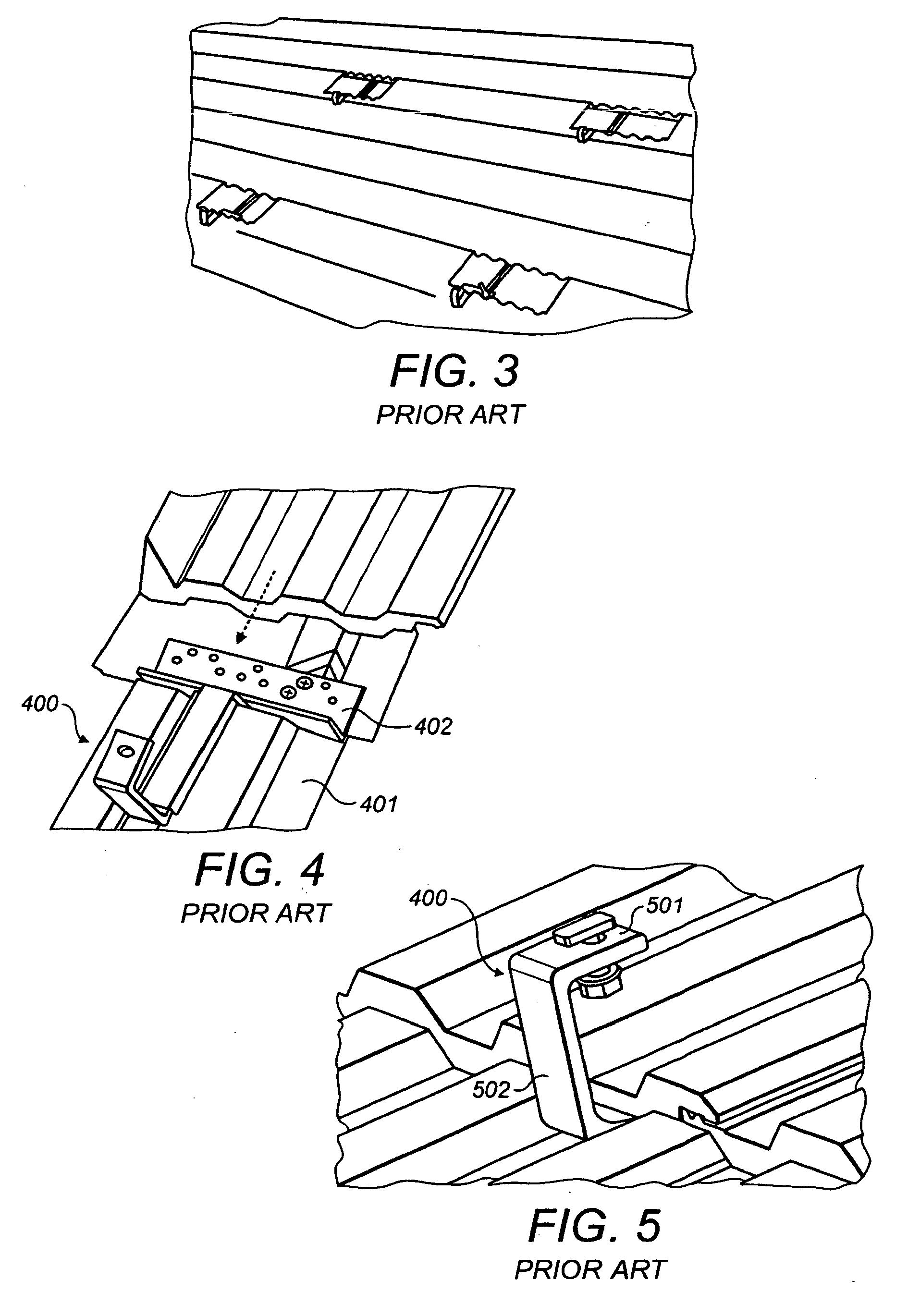
Another known method of installation of an external mounting ("on roof" mounting) for tiled roofs involves removing some of the tiles, attaching mounting brackets to the upright rafters or to horizontal cross beams / noggins joined between the rafters, replacing the tiles to leave the mounting brackets protruding from the tiled roof, and attaching a pair of upright beams between pairs of vertically spaced apart mounting brackets protruding from the roof. Across the pair of upright beams are fitted a pair of horizontal beams, forming a rectangle shape. Pipe connections or electrical cables are passed through holes in the roof, and must be made water tight and weather proof.

[14]
For solar collectors which are installed on a pitched roof it is normal to have some kind of connector or bracket which is lapped into the tiling, with the tiles on top so as to maintain the water tightness of the roof. That mounting has to accommodate different styles of roof tile, which can require different heights of the mounting rail on which to mount the collector, due to different tile depths

[15]
The amount of labor required to retro-fit solar panels or arrays and the difficulty of installation are a major component in the overall cost of a solar panel installation. The finished job must be waterproof and weather tight, reliable, robust and able to resist high winds, storms, extended hot sun light, snow, ice and all the usual weather conditions.

[16]
Referring to Figure 2 herein, there is illustrated schematically, a human operative in the final stages of fixing a flat array of solar tubes to a pitched tiled roof. The operative has already fixed a pair of upright rails 200, 201 parallel to the tiles, and has mounted a pair of cross spars 202, 203 and a tube manifold 204 horizontally across the rails. The rails 200, 201 are attached to the roof by a set of mountings 205 which pass underneath the tiles, and are secured to horizontal battens underneath the tiles. This involves an operative crawling up a ladder on the roof and removing part of a row of tiles.

[17]
Known mountings for external solar panel fixings rely on a pair of horizontal or upright rails, with one or more cross members, with the solar panel or solar array being mounted to the cross members. Not all installations use the upright rails, and the horizontal beams may be attached directly to the mounting brackets.

[18]
To complete the installatio…
Чертежи

Галерея графических материалов, полученных по документу.

Чертеж 1
Файл: /media/National/EP/B1/2014/02/12/2362162/00000001.tif/png
Размер: 164x225
Чертеж 2
Файл: /media/National/EP/B1/2014/02/12/2362162/00000002.tif/png
Размер: 160x232
Чертеж 3
Файл: /media/National/EP/B1/2014/02/12/2362162/00000003.tif/png
Размер: 164x171
Чертеж 4
Файл: /media/National/EP/B1/2014/02/12/2362162/00000004.tif/png
Размер: 156x148
Чертеж 5
Файл: /media/National/EP/B1/2014/02/12/2362162/00000005.tif/png
Размер: 163x171
Чертеж 6
Файл: /media/National/EP/B1/2014/02/12/2362162/00000006.tif/png
Размер: 107x230
Чертеж 7
Файл: /media/National/EP/B1/2014/02/12/2362162/00000007.tif/png
Размер: 154x118
Чертеж 8
Файл: /media/National/EP/B1/2014/02/12/2362162/00000008.tif/png
Размер: 114x222
Чертеж 9
Файл: /media/National/EP/B1/2014/02/12/2362162/00000009.tif/png
Размер: 147x225